


How AI is transforming future real estate projects
In an environment characterised by mounting pressure on costs, stricter ESG requirements and the need to safeguard investments, artificial intelligence (AI) brings many benefits in building design and construction site management. GSE is now integrating it into its projects – helping to improve the performance and sustainability of our clients’ real estate assets.
Making better decisions from the project’s earliest stages
Did you know that up to 80% of a building’s performance is determined at the design stage? This is when AI develops its full potential by providing rapid, reliable and immediately actionable insights.
For example, two tools developed by GSE to assess the carbon footprint and energy performance of buildings are gradually incorporating AI to better anticipate project design.
Predicting your carbon footprint with Quick Carbon
Using its in-house tool Quick Carbon, GSE can assess the carbon footprint of several design options for an industrial or logistics building – within a matter of hours. This innovative approach offers several tangible benefits:
- Quickly compare several technical options
- Identify solutions that enable a significant reduction in carbon emissions for particular subcontracts
- Avoid design choices with excessively negative environmental impacts
In a 10,000 m² building, replacing traditional fiber-reinforced concrete flooring with low-carbon fiber-reinforced concrete flooring (CEMIIIA) saves more than 140 metric tons of CO2—the equivalent of 150 round-trip flights between Paris and New York.
Optimising energy use with Quick Energy
Also in the design phase, the Quick Energy app simulates the building’s energy performance and provides measurable results. It enables us to:
- Carry out scenario tests in just a few clicks
- Identify opportunities for optimisation that could reduce energy consumption by 5% to 20%.
Immediate reductions in operating costs
Reducing GSE’s downstream Scope 3 carbon emissions—which account for emissions resulting from the operation of delivered buildings throughout their entire lifecycle—is a strategic priority. Downstream Scope 3 encompasses indirect emissions generated after the construction and delivery of buildings, particularly those related to energy consumption during the use of equipment (heating, air conditioning, lighting, etc.) and the use of buildings by their occupants. These emissions account for a significant portion of the total environmental impact of projects carried out by GSE.
A tangible benefit: For an industrial site, these adjustments can result in annual savings of tens of thousands of euros, thereby enhancing the asset’s overall profitability.
Thanks to AI, these two internal tools (Quick Carbon and Quick Energy) will soon be even faster and more accurate in their preliminary assessment of carbon emissions—particularly those related to downstream Scope 3 emissions—and the energy performance of buildings designed by GSE. This will not only reduce the environmental footprint of delivered projects but also sustainably optimize their operating costs.
Taking a 360° perspective to safeguard investments
AI helps GSE ensure that investments are secure and aligned with our clients’ ESG priorities. Two main elements stand out:
A thorough study and design phase
Getting started on a proposed project involves the in-depth analysis of client requirements and tender specifications, followed by the actual project design. Thanks to various AI solutions, GSE is be able to:
- Gain a quicker understanding of client needs
- Enhance design by capitalising on GSE’s long experience
- Optimise proposals & pricing by mining internal databases containing 50 years’ of diverse projects
A GSE Expert comments on AI in Engineering applications

“The engineering field is an ideal application for AI, and here’s why: First, we handle a huge amount of data—materials, quantities, prices… All this information is strategic at GSE, and yet we weren’t always making full use of it because it was so time-consuming. With AI, everything changes: we can analyze millions of data points in a matter of seconds, identify what’s essential, and make better decisions.
Second, our line of work still involves many repetitive tasks, such as analyzing requests for proposals or verifying quantities. These are useful tasks, but they aren’t the ones that create the most value. Thanks to AI, we can automate these tasks and focus on what really matters: understanding client needs, scrutinizing projects, and ensuring solutions are sound.
In practical terms, with tools like Tenderbolt, we’re already seeing initial benefits: we can quickly extract key information from requests for proposals—reducing hours of reading and analysis to just a few minutes.
But what’s even more promising is the future:
- Pricing management: In the future, AI will enable us to quickly test scenarios in the face of cost volatility, allowing us to be more responsive and…
- Carbon footprint: Easily integrate financial and environmental costs from the very beginning of a project’s planning.
In short, yesterday we spent too much time searching for and organizing data. Today, we’re able to analyze it much more quickly. And tomorrow, we’ll be able to simulate, compare, and make decisions more effectively.
With AI, we’re already on the right track, and this is just the beginning.”
Sébastien Delcourt – Director of Research GSE Régions
Sustainable performance in operation
Following the design phase, data analysis remains essential for ongoing management. GSE is, in particular, exploring energy optimisation solutions that enable:
- The best-suited energy infrastructure elements to be installed, such as solar farms, building components, battery storage, EV charging points, etc.
- The optimisation of the site’s overall energy consumption
- A lasting reduction in operating costs and an increased long-term asset value
Better construction site management with powerful digital tools
AI and digital technology do not stop at the design stage: they are also transforming site management. GSE offers dedicated tools to improve safety, traceability and coordination:
Innovative solutions for improved site management
GSE is currently testing several innovative AI-driven solutions, including:
- Making better use of existing data: for example, digital twins for energy management and optimization, which have become too complex for humans to handle.
- Enabling new applications through the use of images; for example, two solutions are currently being tested at GSE:
A solution for detecting safety risks and issuing alerts when necessary;
A solution for automatically monitoring construction site dumpsters to optimize their turnover and detect sorting errors;
« As in all industries, AI can accelerate sustainable innovation—provided it is used in a useful and thoughtful manner.
In summary: of course, AI will be useful—but innovation will remain performance-driven: our goal is a measurable improvement in our projects and our business operations. »
Hélène Galleyrand, Directot of Innovation

BIM: our projects’ digital backbone
Building Information Modelling (BIM) has become the cornerstone of project management at GSE. Our digital models centralise all the buildings’ technical data and provide major benefits:
- 3D visualisation of the facility right from the design stage – for fast & informed decision-making
- Real-time coordination between all project stakeholders
- Early detection of technical incompatibilities, reducing the need for changes during works
- Reliable 2D drawing production and quick updates
- Reliable data transfer for future operation
Thanks to this approach, investors and industry users benefit from reduced risks and the long-term improvement of their assets’ performance.

“In my line of work, I mainly use AI to process the data we export or import into the model via Excel spreadsheets. On the MRS5 project, we took it even further—and that’s where, for me, AI really makes a difference: it allowed us to build processes that would previously have required weeks of manual work. With its help, we created an automated program that reads the BIM model and directly extracts the information we need. Next, we used AI to create Excel automations that organize, complete, and verify this data all on their own. These are repetitive and time-consuming tasks that we were able to automate from start to finish thanks to AI, saving us valuable time that we can reinvest in tasks with higher added value.”
James Sanders – Technical Synthesis Manager
The Blue Suite® Configurator
The Blue Suite® Configurator is a unique tool developed by GSE, designed to help investors and industry players visualise and quantify a project’s environmental impact before construction begins. This data-driven approach transforms ESG ambitions into informed decisions and measurable results.
Here’s what The Blue Suite® actually enables:
- Simulating various design scenarios to assess their environmental and financial impacts
- Quantifying the potential reductions in CO₂ emissions, energy savings and the return on investment for each alternative.
- Providing reliable and quantifiable indicators to guide decision-making.
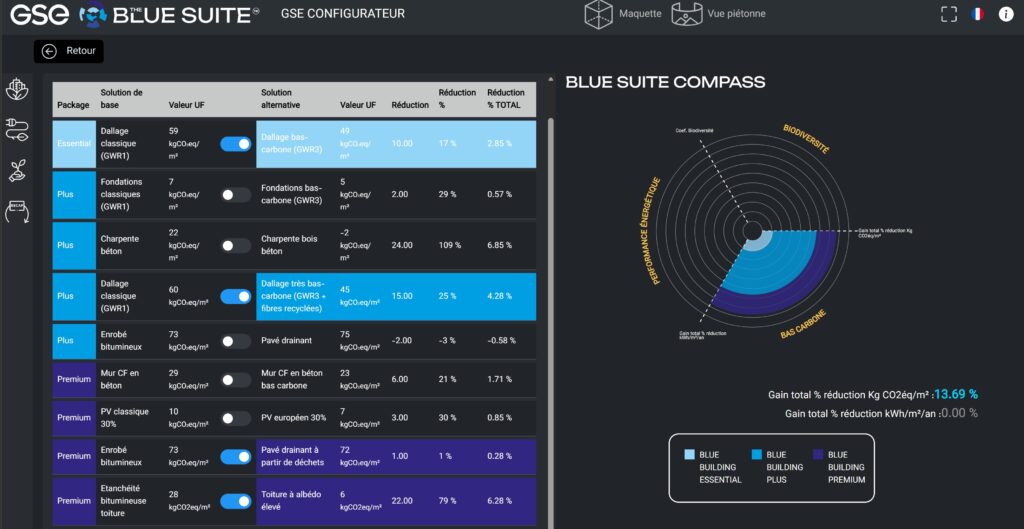
Thanks to AI integration, future developments in The Blue Suite® will take it even further by generating accurate predictions of projects’ short- and long-term impacts.
This innovative solution gives industry players and investors the practical means to achieve their ESG objectives while maximising their projects’ performance and profitability.
https://www.gsegroup.com/the-blue-suite/
By relying on technologies such as BIM and The Blue Suite® Configurator, GSE reaffirms its commitment to providing innovative and practical tools. These enable clients to manage their projects more effectively, reduce risks and maximise both their sustainability and their profitability.
A pragmatic, results-focused approach
GSE focuses on the pragmatic and practical use of AI tools. They are integrated from the projects’ earliest stages and deliver measurable benefits from the outset.
Tangible benefits for real estate development projects
The integration of artificial intelligence into real estate projects is more than just a simple modernization: it is already delivering concrete, measurable results, and these benefits will be further enhanced by future advancements in AI, here are some highlights:
- Optimization of MEP building design, by more quickly understanding client needs on the one hand and leveraging numerous past projects on the other;
- A reduction of 2% to 5% in the “construction” carbon footprint of projects.
- A decrease of 5% to 15% in energy consumption.
- An overall improvement in the medium-term profitability of assets.
Thanks to AI, these positive results observed today can be further amplified tomorrow, with more precise, adaptive, and effective solutions to address the environmental and economic challenges of real estate projects.
AI: complementing human expertise
At GSE, artificial intelligence does not replace human expertise: it enhances it. These decision-making tools enable GSE to support clients in addressing their industrial, financial and environmental challenges.
In practical terms, this means: lower risks, better performance, and greater control over investments.

