


Rethinking land use: a fundamental challenge for sustainable development
What am I? A single teaspoonful of me can contain more microorganisms than there are human beings.
Soil: a living resource and an asset for the future
Time’s up for the old attitude: land is NOT just a surface to be exploited. With the climate going berserk and species disappearing one after another, we’re beginning to better understand the value of soil. It’s no longer merely a place for our infrastructures, but a living resource to be preserved.
A spoonful of healthy soil contains more microorganisms than there are people on Earth. All too often reduced to a mere surface to build & dwell on, soil is in fact an invaluable collective asset, essential to ecological, climatic and hydrological equilibria. At GSE, we have made soil a priority for our development projects. Our Contaminated Sites and Soils Manager plays a key role in this mission, by ensuring that this invisible yet fundamental resource is analysed, preserved and restored. Why? Because soil is the vital heritage of the generations to come.
In this article, we take a closer look at the challenges & issues surrounding soil, the misunderstood treasure that is essential to our future.
“Designing in” soil: a strategic priority
The design phase: a key moment for preservation
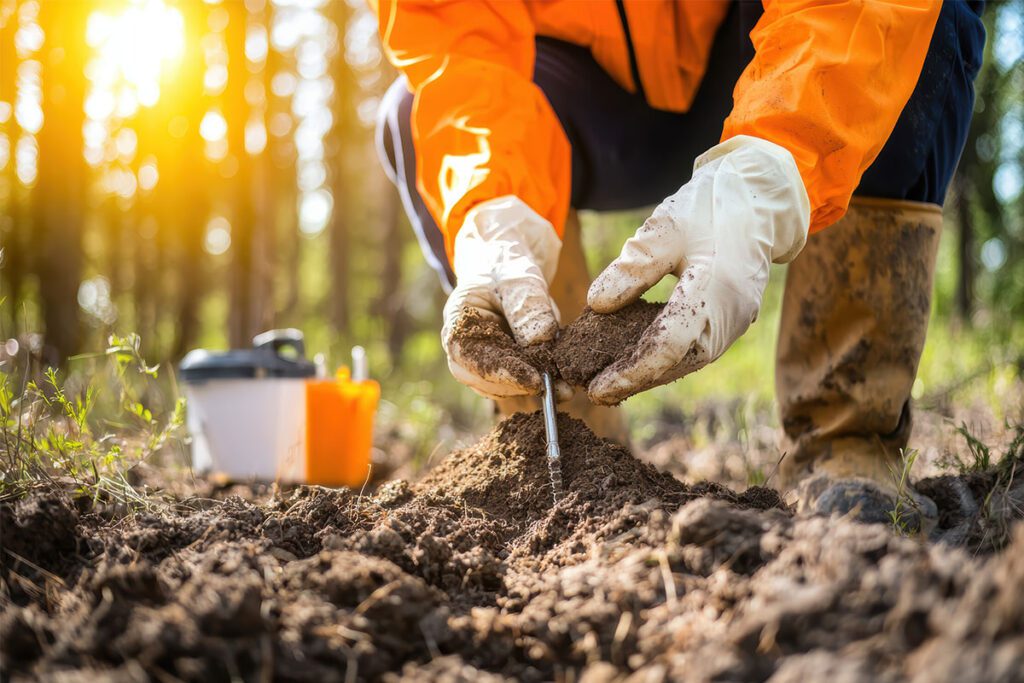
Development projects can no longer ignore the key role played by soil. Reflecting climatic concerns and legislative requirements, the status of soil is changing. Our contaminated sites & soils expert assesses it from the project’s earliest stages, informing an appropriate management strategy. Controlling the quality of excavated soil is essential to the circular economy: it enables us to reduce disposal, capitalise on local resources and minimise our ecological footprint.
However, complex issues, such as the management of modern pollutants – like PFAS, the ‘forever chemicals’ – are redefining critical thresholds. These substances require advanced solutions to avoid any negative impact on the project and the environment. Failure to cover these issues early on can turn a deposit of usable soil into a genuine technical and financial headache.
A 360° perspective
Of course, we build on the ground. But it is soil’s capacity to harbour life that confers its greatest value for urban development. At GSE, we are reinventing project design by incorporating renaturation solutions and ecological features. For example, a “sponge city” prioritises natural infrastructure for managing rainwater, thereby strengthening the local community’s resilience against flooding.
Building today means striking a balance between preserving living soils and the need to install buildings and infrastructures. We must bear in mind that every square meter of sealed soil is a net loss for future resilience.
From civil engineering to bioengineering
A circular approach to land management
At GSE, we take an innovative approach to soil management, with circularity as our guiding principle. Where possible, reusing excavated soil on-site offers an alternative to systematic disposal, which is always costly and polluting. While disposing of soil costs €25 per cubic meter on average, managing it on-site can reduce this cost to €5/m3, based on methods in line with the circular economy. By combining geotechnical analysis with pollution assessment, we identify deposits of soil that can be used directly on-site. Some soils that do not meet the criteria for inertness can be reused according to specific strategies.
Unlocking soil’s natural potential
Soil is home to over 59% of the world’s biodiversity. This biological wealth supports the fertility, resilience and future sustainability of natural – or thoughtfully developed – spaces. At GSE, we promote this biodiversity by recovering and reusing topsoil on-site. This reduces pressure on external resources and ensures that the developed sites are as adaptable as possible. Our approach is based on responsible management, where every plot of land plays a vital role in the robustness of infrastructures and environmental resilience. A forward-looking perspective on soil means viewing it as a strategic driver of sustainable development.
A natural infrastructure for water management
In many projects, we replace conventional infrastructures with natural solutions. Ponds are designed to support wildlife, enhancing the biodiversity of the local area. These initiatives transform the land into a useful & sustainable ecological infrastructure. It also improves water quality, mitigates flooding, and enriches the surrounding environment, turning the land into a resilient and self-sustaining ecological infrastructure.
Redeveloping brownfields to build compact cities
Putting a stop to urban sprawl
The real estate sector has to accept the simple fact: we can no longer let our cities spill out onto fertile land. In this context, brownfield and contaminated sites are precious resources. These sites may be more difficult to recover & redevelop, but they offer a unique opportunity to curb urban sprawl and breathe new life into abandoned zones.
Redeveloping brownfields: where revitalisation meets public safety
The redevelopment of brownfield sites brings two key benefits:
- ecological revitalisation, which restores natural cycles, recreates ecosystems and enhances their ecological functionality
- safety, where maintaining a neutral balance ensures that pollution and natural hazards are controlled and their impact is managed.
A forward-thinking approach, combined with specialist engineering, makes it possible to overcome technical, health and financial constraints. Success lies in matching environmental ambitions and technical feasibility.
Soil as a powerful network
Surface sealing, the killer of ecosystem services
Buried under concrete, meter after meter of soil loses its essential functions: water infiltration, carbon storage, temperature regulation and biodiversity. In the urban age, we must make our land-use decisions with a view to the ecosystem services provided – or lost.
Strategic restoration
Based on soil studies, we aim to build new infrastructures on the least productive surfaces. This strategic approach helps to preserve fertile land with high infiltration potential – and maximises the projects’ sustainability.
At GSE, we no longer think of soil as an inert substance. It’s a dynamic, living resource upon which the success of tomorrow’s projects depends. Our team assesses the soil of approximately 50 projects each quarter. These surveys are based on strict environmental criteria: biodiversity, site contamination and opportunities for the circular economy.
By transforming degraded land into functional soil and by incorporating environmentally friendly solutions from the design stage, we are driving sustainable development. Long overlooked, soil is now seen as the foundation of resilient local environments. In this perspective, every project is an act of responsible & innovative construction, transforming what lies beneath our feet into a living resource for the communities of the future.

