


Number of the day 8 kg per m²
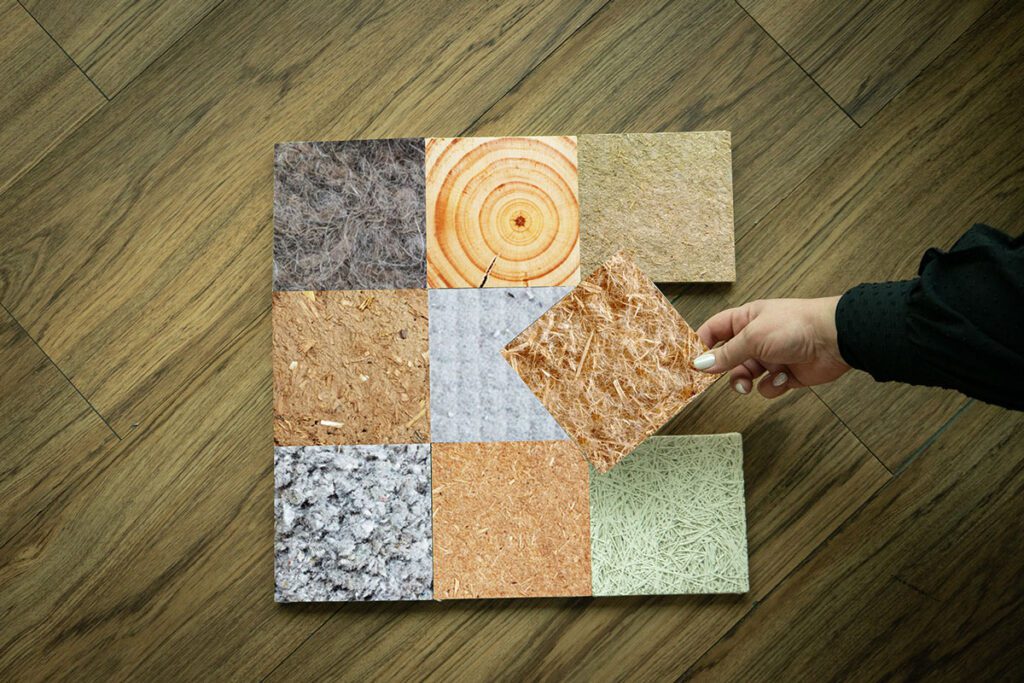
In 2025, GSE achieved an average of 8 kg of bio-based materials per m² of floor space delivered – whether in new builds, renovations or extensions. This is an important achievement – and we couldn’t have done it without our clients’ backing.
In the drive to reach net zero GHG (Green House Gases) emissions by 2050, our main focus will be on decarbonising the emission heavyweights – concrete, metal and rock wool – as well as on airtightness. The use of bio-based materials is an essential step in this process. We set ourselves a short-term target: by 2030, at least half of our logistics projects should have 10 kg of bio-based materials per m² of floor space, and more than 15 kg/m² in services sector projects.
By way of comparison, the level 1 of France’s Bio-based Building label, applied to new buildings in the services sector, requires an average mass of 18 kg m² of wood and other bio-based products per m² of floor space.
But what’s a bio-based material?
Bio-based materials come from biomass. They are sourced partly or entirely from plants (e.g. straw) or animals (e.g. sheep’s wool). These materials come mainly from the forestry, agriculture or recycling sectors.
They have many applications: they can be used in building insulation, in structural elements, or as coatings.
Focus on bio-based materials
Plant biomass offers a wide range of sustainable and renewable materials, suitable for various uses depending on their form and properties.
- Wood: Used in the form of wood wool, wood fibre boards, timber or loose wood, wood is prized for interior and exterior insulation. However, wood wool must be treated to protect it from insects and mould.
- Hemp: A plant that is resistant to insects and capable of regulating humidity, hemp has many uses. Once defibrated, its stem becomes shives or chaff, which are used in bulk. Hemp wool, on the other hand, can be used as a coating or mixed to make mortar.
- Flax: France, the world’s leading producer of flax, provides local access to this material. Flax is known for its excellent insulating properties.
- Straw: Available in bales, compressed panels or mixed with earth to produce coatings, straw is a versatile material, particularly for insulation.
- Cellulose wadding: Made from recycled newspapers, cellulose wadding is transformed into insulation panels or used in bulk, providing an environmentally friendly insulation solution.
Bio-based materials, such as wood in structures, or insulation materials such as hemp and straw in construction or renovation, play a key role in the evolution of construction practices. Derived from plant biomass, these materials are renewable, high-performance and capable of sequestering carbon. They are considered – quite rightly – indispensable allies in meeting the environmental challenges of tomorrow and should be integrated from the project design stage onwards.
For example, in insulation, the use of wood fibre (instead of conventional rock wool) can reduce the product’s greenhouse gas emissions by up to 60%. In particular, the use of wood in new industrial or commercial building structures is recommended for its double impact: it reduces the carbon footprint and it stores carbon. In dynamic life cycle analyses, which assess buildings’ carbon footprint, bio-based materials have an advantage because they capture greenhouse gases throughout their lifetime, in the same way that plants capture CO2 through photosynthesis.
In addition, elements related to the building envelope, exterior fittings and finishing work (insulation, joinery, cladding, fittings, etc.) are also valued to reduce the project’s overall carbon footprint and improve occupants’ comfort. We offer these options to our clients to meet their needs while delivering on our commitments to sustainable construction.
Promoting bio-based materials: a joint effort
We aim to increase the use of bio-based materials across all our projects. This approach is part of a regional development strategy aimed at supporting specialised sectors and creating local business ecosystems that promote responsible purchasing. This collaborative effort relies on the commitment of all stakeholders (builders, suppliers, project owners, etc.), ensuring the use of high-performance materials that are suitable and accessible at a reasonable cost.
Historically, cost has been a major barrier to their adoption. However, some bio-based products have now reached prices comparable to those of traditional materials, while others are only moderately more expensive. These advances have led to significant uptake: the market share of bio-based materials in France has grown from 1% in 2016 to 11% in 2025, showing strong momentum. For example, bio-based insulation, a niche product not so long ago (its market share was 1% in 2009), reached 11% in 2023.
The technical, environmental and health-related benefits
Bio-based materials deliver superior technical performance that meets the needs of modern projects:
- Thermal resistance: these materials guarantee effective insulation.
- Humidity regulation: they promote a healthy indoor climate by absorbing and releasing moisture.
- Acoustic performance: Thanks to their fibrous structure, bio-based insulation materials are characterised by their excellent sound absorption, significantly reducing noise pollution.
In addition to their technical performance, these materials offer ecological and health benefits. Unlike synthetic materials, which often emit harmful chemicals that affect indoor air quality, bio-based materials are naturally non-toxic and contribute to a healthier environment for occupants. Their use thus improves overall wellbeing and quality of life.
Nevertheless, it should be noted that while bio-based insulation generally outperforms its conventional counterparts in terms of acoustics, this is not always the case for structural materials such as hemp concrete or wood, whose acoustic performance remains below that of conventional solid concrete.
Promising momentum
Driven by their clear technical, environmental and health benefits, bio-based materials have become a key solution for sustainable construction. Their popularity, supported by technological innovations and collective efforts, can be expected to continue to grow in the coming years.
Focus on regulations
France’s 2020 environmental regulation (RE2020) provides the legal framework for new buildings’ environmental and energy performance. Its main objective is to accelerate the transition to low-carbon construction. In particular, it provides for the near-systematic adoption of bio-based materials by 2030, placing these materials at the heart of sustainable construction practices.
In addition, Article L228-4 of France’s Environmental Code actively encourages the use of bio-based materials in public building construction. This provision aims to promote the responsible and sustainable use of natural resources, while supporting the bio-based sector and its environmental benefits.
The materials of the future?
By including bio-based materials, we are rising to the challenge of decarbonisation while breathing new life into our industry and trades. To build differently – in a smart, sustainable and responsible way – is to shape a future that respects our planet and those who will live on it.
Today, we are building the future of construction, in a joint effort where all players – designers, builders, clients, local supply chains – contribute to creating a more sustainable world. Together, we will make the construction industry a impactful player in addressing our current environmental challenges.
“Bio-based materials reduce our carbon footprint, while enabling us to use local, natural and recyclable resources.”
Edouard Delanoe, GSE Green Buildings engineer

